Before we talk capacity, power or price, the first thing we ask anyone shopping for a lift is simple: how tall is your ceiling? It decides which lifts will fit, how high you'll be able to raise a vehicle, and whether two cars can share one bay. The good news is that you can answer it yourself in five minutes with a tape measure.
Step 1: Measure to the Lowest Thing, Not the Ceiling
The number that matters isn't the drywall. It's the lowest obstruction in the spot where the lift will stand. Measure from the floor to the lowest of these:
- The garage door and its track when the door is open. This is the one that catches most people.
- The garage door opener, its rail and any brackets.
- Light fixtures, heaters, beams and ductwork above the bay.
Measure at the actual lift location, and take a couple of readings. Garage floors are often sloped toward the door, so the height can change across the bay.
Step 2: The Simple Formula
For any lift, the ceiling you need is roughly:
How high you want to lift + your tallest vehicle's height + 3 to 6 inches of breathing room
If you don't know your vehicle's height, it's in the owner's manual or a quick search away. As a rough guide:
| Sports cars & coupes | about 48" to 55" |
| Sedans & hatchbacks | about 55" to 60" |
| Crossovers & SUVs | about 64" to 72" |
| Full-size pickups | about 75" to 80" |
For two-post lifts the formula errs on the safe side, because the arms pick the vehicle up a few inches off the ground. For four-post lifts it's spot on, since the tires sit right on the runways.
Ceiling Height by Lift Type
Motorcycle and mid-rise lifts: any garage
If your ceiling is a standard 8 feet, these are your lifts. The Performance Hoist Motorcycle/ATV Lift tops out at 48", and mid-rise lifts like the Atlas Kwik Bay (41" with positioning blocks) and the Atlas Versa (39⅜") raise a car to a comfortable seated or stooped working height for wheels, brakes and suspension. Not full standing height, but a world better than a floor jack.
Two-post baseplate lifts: about 9½ feet and up
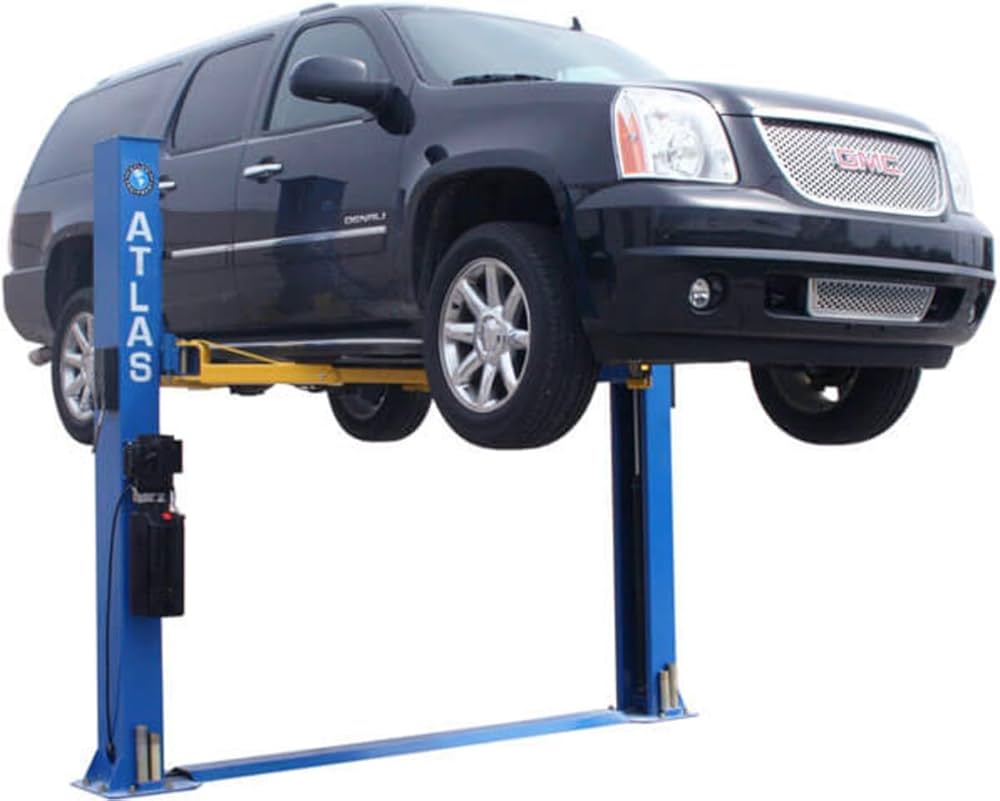
Baseplate lifts have no overhead beam, so the columns are the tallest part. The Atlas BP8000 stands 108" (9 feet) and needs a 9'3" ceiling; the Atlas Platinum PVL-9BP stands 111⅛". That gets the lift into most garages with 10-foot ceilings. How high you can raise a car is then down to the formula above.
Two-post overhead lifts: 12 to 15 feet
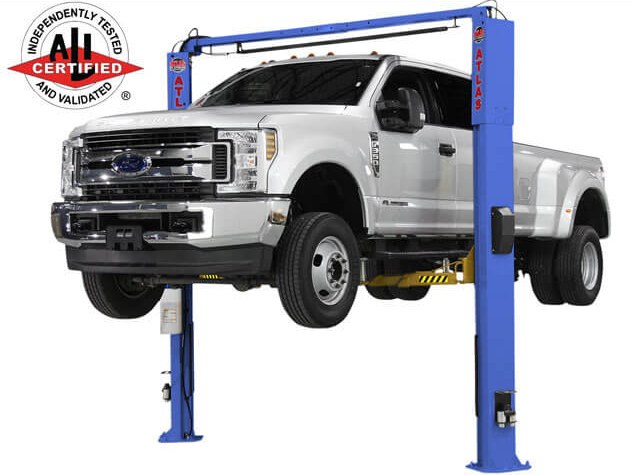
Overhead lifts run a beam across the top of the columns, and that beam needs room. The Atlas Platinum PVL-10 stands 135⅞" or 139⅞" depending on setup, with a cylinder that extends to 12'4" at full rise. The Atlas OH-10X calls for a 13-foot ceiling, the Atlas Platinum PVL-12 sets up at 13'9" or 14'9", and the Atlas Platinum PVL-15 stands 14'6½". These are shop lifts, and most commercial bays are built for them.
Four-post parking lifts: 11 to 12 feet to stack two cars
A four-post lift itself is short. The columns on the Atlas Garage Pro 8000 are 83" and on the Atlas Apex 9 99", so they fit almost anywhere. What needs the height is the car on top. Here's how three of our most popular parking lifts compare:
| Performance Hoist PH8S | 72½" to top of runway, 68" under the runways |
| Atlas Garage Pro 8000 | 72" to top of runway, 67½" under the runways |
| Atlas Apex 9 | 86" to top of runway, 81¼" under the runways |
Three Real-World Examples
- Stacking two cars on a Performance Hoist PH8S. A 55" coupe on top at full height: 72½" + 55" + 4" of breathing room = 131½", or about 11 feet. The car underneath has 68" to work with, so most cars and many crossovers fit. A full-size pickup won't. See a PH8S install near Miracle Beach.
- A two-post baseplate lift in a 10-foot garage. The PVL-9BP fits with room to spare. With a 56" sedan and 4" of breathing room, you can raise the car about 60" before the roof gets close to the ceiling. That's short of the lift's full 74¾", but plenty for wheels, brakes, suspension and exhaust with a bit of a stoop. For full standing height under the same car, you'd want closer to 11'3".
- An Atlas Apex 9 with a truck underneath. 81¼" under the runways clears most pickups. Raising a 56" sedan all the way to the top takes about 12'2" of ceiling. In a lower garage, lock the top car at a lower position and match the vehicle underneath to the space that's left.
Short on Height? You Have Options
- Lock lower. Four-post lifts lock at several heights, so you can park the top car lower to suit your ceiling.
- Move the opener. A wall-mount (jackshaft) opener frees up the space a ceiling-mounted opener takes, and many garage door tracks can be converted to a high-lift setup. A garage door installer can tell you what your door allows.
- Shift the lights. Moving a fixture from the middle of the bay to the side often buys back a few inches.
- Pick the right style. In a low garage, a baseplate or mid-rise lift will do more for you than an overhead lift that doesn't fit.
The Other Three Things We Check
Ceiling height comes first, but it's not the only question. Before any lift goes in, we also look at your concrete floor (every lift has its own slab requirement), your power (several four-post and mid-rise lifts run on 110V, while most two-post lifts need 220V), and the width and length of the bay. Our home garage picks and home garage lift guide are good places to start, and if you're choosing a lift style, our 2-post vs 4-post comparison walks through the trade-offs.