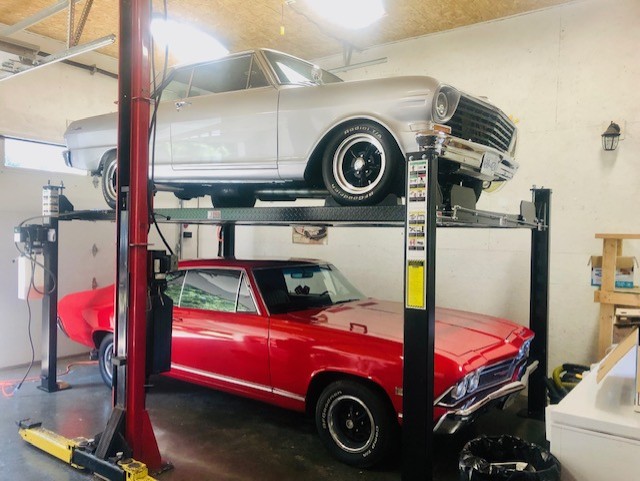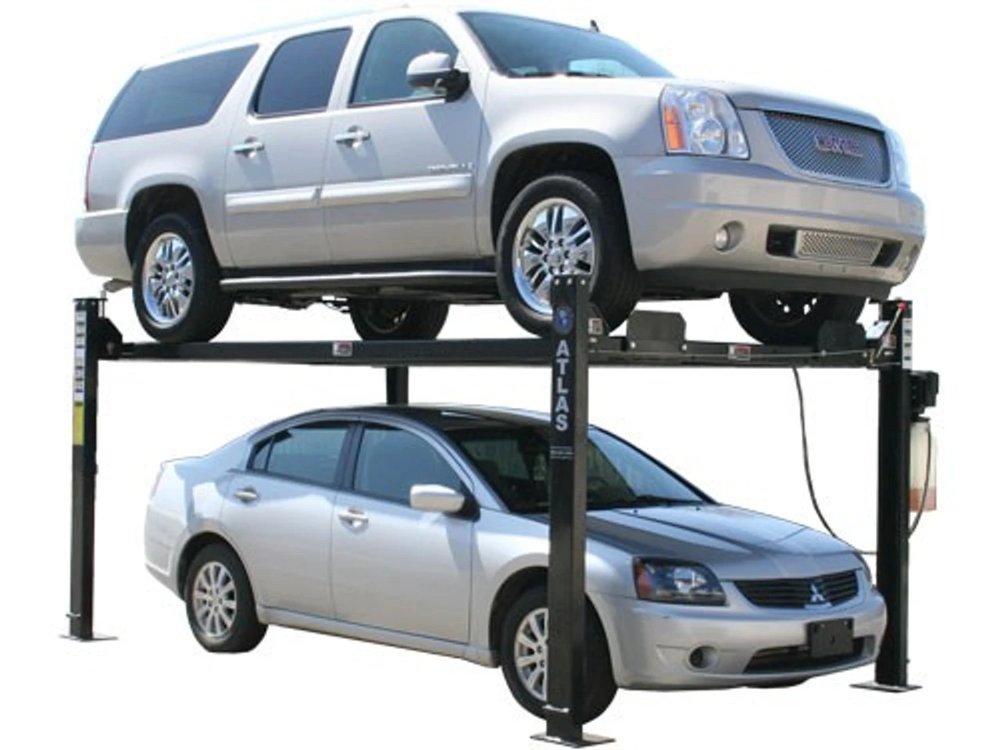
We don't get much snow at sea level on the Island, but we get months of damp. That's what the summer car, the convertible or the classic has to sit through from now until spring. A four-post parking lift makes the storage part easy: the car you won't drive goes up top, the daily driver tucks in underneath, and nobody pays for a storage unit across town. A bit of prep before it goes up decides whether it comes down in April ready to drive.
Before It Goes Up
- Wash it and dry it properly, underneath too. Road grime and salt hold moisture against the metal all winter.
- Clean the inside. Crumbs and wrappers are an invitation to mice.
- Change the oil and filter. Used oil carries acids and moisture you don't want sitting in the engine for months.
- Fill the tank and add fuel stabilizer, then drive or run it long enough for treated fuel to reach the whole fuel system.
- Set the tire pressures to the figure on the door placard.
- Leave the parking brake off. In a damp garage, pads and shoes can stick over a long winter. Wheel chocks on the runway do the job instead.
Parking It on the Lift
This is where a four-post earns its keep, as long as you use it the way it was designed:
- Always set it down on the locks. Raise the car past the height you want, then lower it onto the mechanical locks so it rests on steel, not hydraulics. The lifts we recommend for parking all use lock ladders in the columns: the Performance Hoist PH8S, the Atlas Garage Pro 8000 and the Atlas Apex 9.
- Put the drip trays in place. They protect whatever is parked underneath. The PH8S comes with six, the Garage Pro 8000 with three, and the Apex 9 includes them too.
- Check the car underneath fits. The space under the runways is 68" on the PH8S, 67½" on the Garage Pro 8000 and 81¼" on the Apex 9. Measure the car or truck that will live below, and leave yourself a margin.
- Check the space above, too. Measure from the roof of the parked car to the lowest thing above it, including the open garage door. Our ceiling height guide walks through the math.
- Route the battery tender cord so it can't catch on the runways or get pinched if you raise or lower the lift.
Keeping the Damp and the Mice Out
- Use a breathable car cover. A plastic sheet or tarp traps condensation against the paint, which is the opposite of what you want.
- Put a moisture absorber inside the car, and check it every few weeks.
- Keep the battery on a tender, or pull it and store it somewhere it won't freeze.
- Keep mice out. Set traps or deterrents around the lift, and if you plug the tailpipe or air intake, leave a note on the steering wheel so you remember in spring.
- Only start it if you'll let it warm up. A short idle in the garage makes condensation in the engine and exhaust without burning it off. If you start it over the winter, let it come right up to temperature.
Check In Once a Month
A quick look every few weeks catches problems early. Make sure the tender's light says charged, look at the drip trays for anything new, check for signs of mice, and confirm the lift is still sitting on its locks. If anything on the lift doesn't look or sound right, call us before you use it again.
When Spring Comes
Pull the tailpipe plug and anything else on your note, reconnect or reinstall the battery, check the tire pressures and fluid levels, then lower the car off the locks. A little surface rust on the brake rotors is normal after a damp winter and clears after a few gentle stops. Then go for a drive.
No Parking Lift Yet?
If the summer car is sitting under a tarp in the driveway this year, a four-post parking lift is the fix. The Performance Hoist PH8S runs on standard 110V power and is the one we install most often in home garages. See it in a real garage in our Miracle Beach install story, or compare all our four-post lifts. Every lift we sell qualifies for $0-down lease-to-own financing through Lease Link Canada.